28 September 2025
Loading



Velmor Teknoloji
27 October 2025
IoT and automation are no longer experimental — they’re core components of modern industrial efficiency. Companies adopt them today to solve three main problems:
Visibility: Real-time tracking of downtime, cycle times, and energy usage.
Responsiveness: Detecting anomalies before they become failures.
Standardization: Integrating multi-brand devices and unified data structures.
Quick wins (0–90 days):
Collect cycle time and downtime data for loss analysis.
Monitor line-level energy consumption and peak-hour alerts.
Automate preventive maintenance through rule-based triggers.
Field Layer: Sensors (temperature, vibration, current), PLCs, robots, HMIs.
Edge Layer: Industrial PCs or gateways for data collection, filtering, and protocol translation.
Data Layer: Time-series databases, message queues, event logs.
Application Layer: SCADA/MES dashboards, alerts, energy/quality modules.
Security Layer: Certificates, role-based access (RBAC), and network segmentation.
Deployment models:
On-premises: Low latency, full data ownership, higher maintenance.
Hybrid / Private Cloud: Centralized visibility with VPN or SD-WAN security.
Modbus RTU/TCP: Legacy-friendly, simple structure.
OPC UA: Secure, standardized, cross-platform; ideal for MES/SCADA integration.
MQTT (with Sparkplug B): Lightweight, publish/subscribe messaging; great for edge-to-cloud.
Profinet / EtherNet/IP: Deterministic control for robot and PLC cells.
REST / GraphQL APIs: For ERP, CMMS, and external integrations.
👉 Rule of thumb: Use deterministic industrial protocols for field control; use MQTT or OPC UA for upstream analytics and cloud integration.
Network Segmentation: Separate OT and IT networks; control traffic via firewall rules.
Zero Trust Model: Device certificates and identity verification for every node.
Encryption: MQTT over TLS, OPC UA Secure Channel, encrypted data storage.
Access Management: RBAC + MFA with complete audit logs.
Patch & Inventory: Keep firmware/software inventory with scheduled updates.
Incident Response: SIEM integration, anomaly detection, and response playbooks.
OEE (Overall Equipment Effectiveness):
OEE = Availability × Performance × Quality
MTBF / MTTR: Mean time between failures / mean time to repair.
Energy Intensity: kWh per product unit (piece, kg, m²).
Quality Yield / PPM: Real-time quality and defect rates.
Downtime Pareto: Categorized loss tracking (reason, duration, frequency).
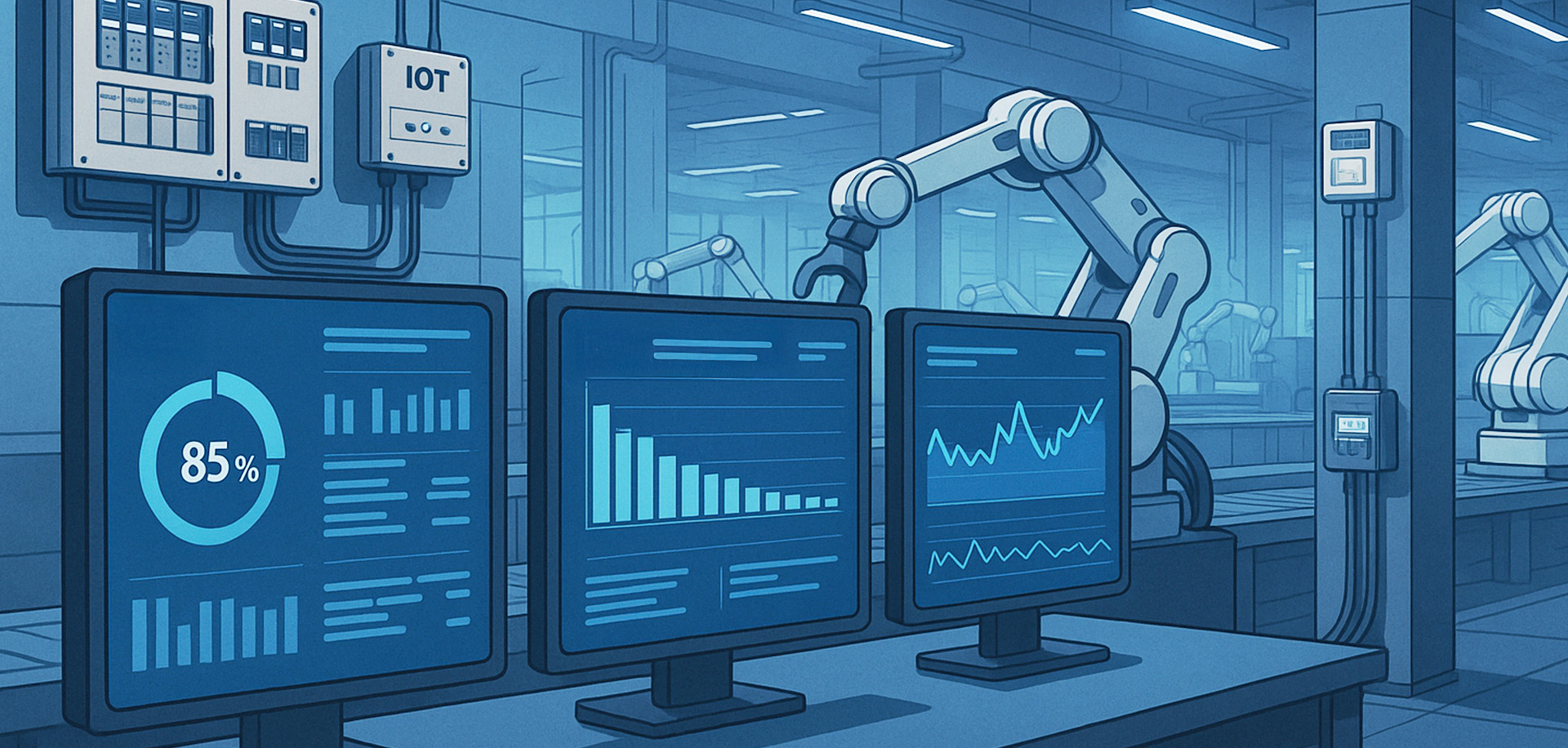
These KPIs form the backbone of every IoT dashboard deployed on the factory floor today.
Annual Savings =
(downtime hours reduced × hourly line cost)
(energy savings × unit energy price)
(scrap reduction × rework cost)
(maintenance reduction × average labor cost)
Payback Period = Investment / Annual Savings
Typical ROI ranges from 9 to 18 months, depending on the production line and project scope.
SCADA/PLC → Edge: Collect data via OPC UA; normalize tag structure.
Edge → Platform: Send data with MQTT QoS1 and buffering for network loss.
Platform → MES/ERP: REST API or OPC UA server connections for production orders, recipes, and costing.
Maintenance (CMMS): Trigger work orders based on vibration or temperature anomalies.
Quality (QMS/LIMS): Automatic halt or alerts when SPC limits are breached.
Week 1: Discovery & Objectives – Select pilot line, define KPI targets, build tag list.
Week 2: Hardware & Architecture – Gateways, topology, and security policies.
Week 3: Protocol Mapping – Connect PLCs, normalize tag naming.
Week 4: Dashboards & Alerts – Build OEE, energy, downtime screens and notifications.
Week 5: System Integration – MES/ERP/CMMS API connections, user roles, training.
Week 6: Go-Live & Monitoring – Activate alarms, validate SLOs, track improvements.
Collecting too much data: Prioritize critical tags; apply downsampling.
Inconsistent naming: Use a clear hierarchy (Line.Station.Device.Tag).
Vendor lock-in: Choose open protocols and modular architecture.
Ignoring security: Segment networks before connecting devices.
“Data lake without dashboards”: Start visualization early — OEE, energy, downtime Pareto.
Energy Monitoring: Meters → Edge → Time-series DB → Peak alarms.
Predictive Maintenance: Vibration/temperature → thresholds + trend → CMMS order.
SPC Quality Control: Measurement → dashboard → auto-stop if out of limits.
Cell Performance: PLC cycle time, downtime classification, OEE reports.
EV Charging Operations: Station telemetry → dynamic pricing → real-time fault alerts.
CapEx: Gateways, sensors, networking, licenses.
OpEx: Cloud infrastructure, monitoring, support, calibration.
Contracts: SLA, data ownership, security audits, and exit clauses.
Vendor Selection: Reference deployments, PoC success metrics, open standards.
IoT and automation today are not future visions — they’re active infrastructure in factories worldwide.
The formula for success is clear: Measure → Visualize → Standardize → Automate.
When executed with structured architecture, strong cybersecurity, and meaningful KPIs, these projects deliver measurable results within months — not years.